Case Study 03

The Essential
Housing Toolkit.

Transforming a complex housing resource library into a user-centric guidance tool, validated through 13 usability sessions with real housing stakeholders across government, state agencies, and community partners.

Essential Housing Toolkit
Client
Building Communities Playbook
Role
Lead Product Designer
Platform
Web
Timeline
Ongoing
Tools
Figma · FigJam · Excel · User Testing

The challenge.

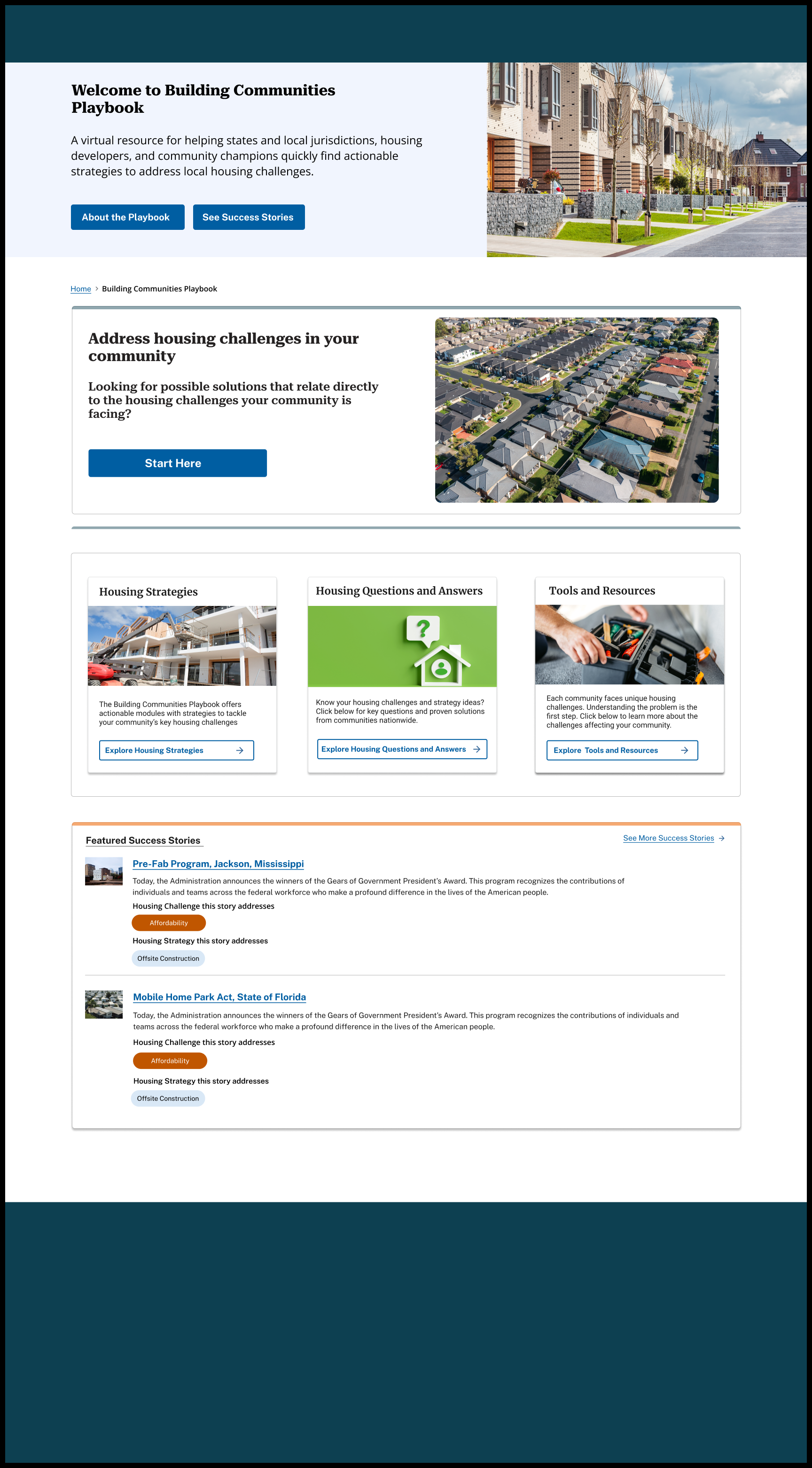
The Building Communities Playbook is an interactive tool developed for grantees and housing stakeholders to quickly identify and implement strategic solutions for local housing crises. A functional prototype had been built, but it needed rigorous usability testing to ensure that complex housing strategies were accessible and actionable for local government staff and community partners.

Users were struggling to navigate a vast landscape of housing resources. The Toolkit's information architecture wasn't meeting users where they were: people don't search for tools, they search for answers to specific housing problems.

"Users don't search for tools; they search for answers to specific problems. The IA needed to be reoriented around Housing Challenges, not technical strategy names."- Laurence L

Project Impact

13
Usability sessions
with real housing stakeholders
100%
User consensus
on localized filtering priority
2.0
Ease of use score
strong foundation on 1–7 scale

Where the prototype broke down.

I facilitated 13 qualitative usability testing sessions with representative housing stakeholders, going beyond simple task completion to understand how users perceived the toolkit's mental model. Three friction patterns emerged consistently across all sessions.

Navigation
Users frequently missed critical content like success stories because it was placed below the fold or within a confusing visual hierarchy; high-value content was effectively invisible.
Terminology
Labels like "Curated Resources" and "Housing Q&As" felt generic, failing to communicate the actual value of the content. Users couldn't predict what they'd find before clicking.
Discovery
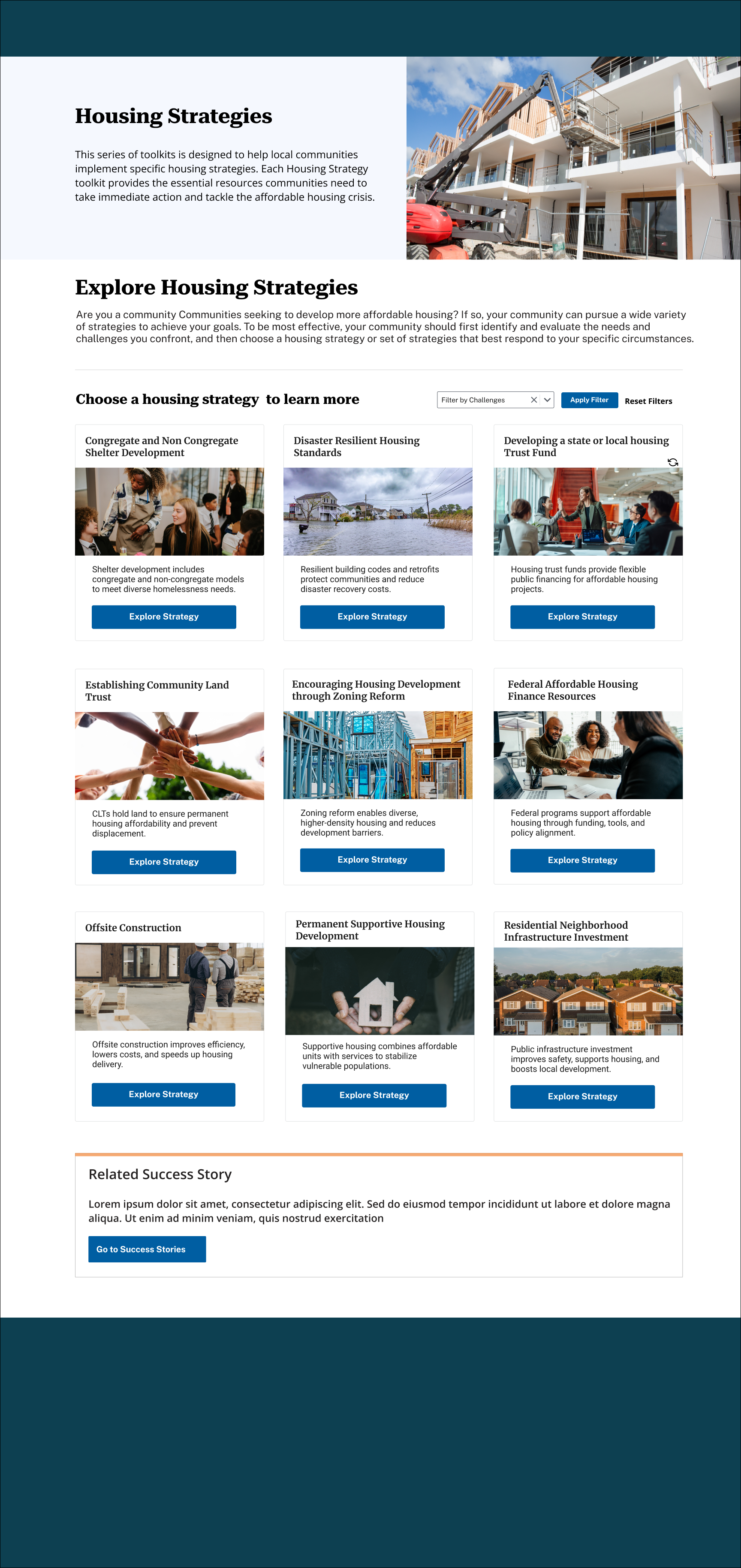
The "Guided Search" feature, intended to simplify the experience, was viewed by most users as less efficient than manual filtering, becoming a source of friction rather than a shortcut.
Language matters: "Strategies" not "Solutions"

Users strongly preferred "Strategies": a strategy implies something adaptable to local context, whereas a solution implies a single fixed answer. One word change, significant trust shift.

Peer proof requires local relevance

Success stories were the most valued content, but only when filterable by community size and region. Generic success stories felt irrelevant; locally comparable ones drove engagement.

Problem-first navigation

Users navigated by housing challenge (e.g., high rental costs, lack of supply), not by strategy name. The IA needed to meet users at their problem, not at a technical taxonomy.

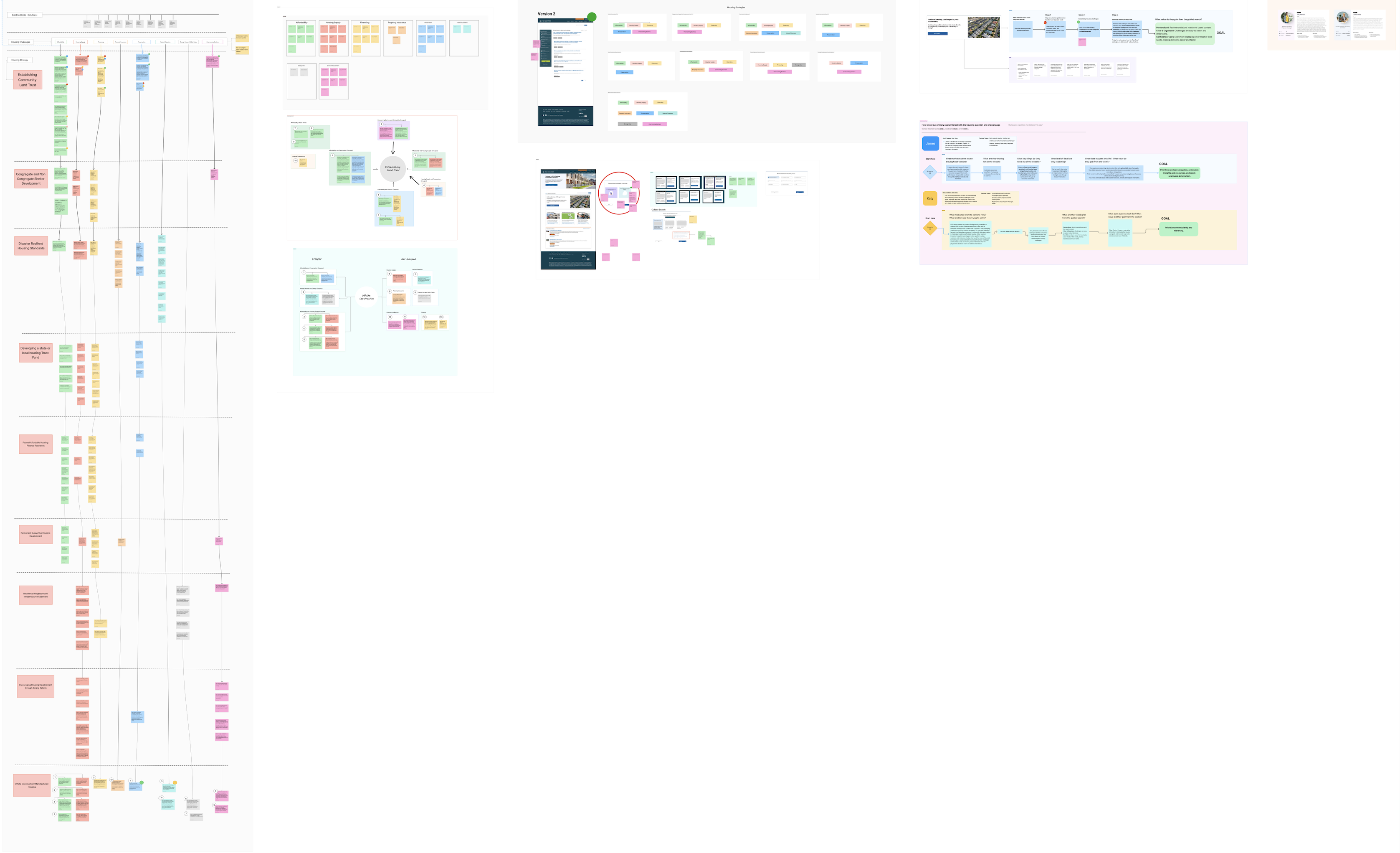
Housing process map
Housing process map – research & design synthesis

Three audiences, one platform.

Research identified three primary user groups with distinct needs and workflows. Testing focused on the most active participants to ensure findings were representative and actionable.

Local Gov. Staff
Primary User
Needs actionable, credible proof of progress to support housing-funded program administration. Searches by specific challenge, not by tool name.
Program Administrator
State Agency Staff
Power User
Looking for scalable strategies that can be overseen or replicated across multiple jurisdictions. Values data and regional filtering for cross-comparison.
Policy Strategist
Local/State Partners
Community Partner
Non-housing grantees seeking partnership opportunities and practical toolkits for community development. Need clear entry points and plain-language content.
Community Developer
Process flow diagram
Process flow – user journey mapping

From friction to a validated design strategy.

13 usability testing sessions

Facilitated qualitative sessions with representative housing stakeholders (local government staff, state agencies, and community partners) using a functional prototype as the test vehicle.

Ease-of-use quantification

Participants rated the prototype on a 1–7 scale across key task flows. The 2.0–2.4 average validated the foundation while precisely pinpointing Guided Search as the primary UX friction point.

Agile iteration on wireframes

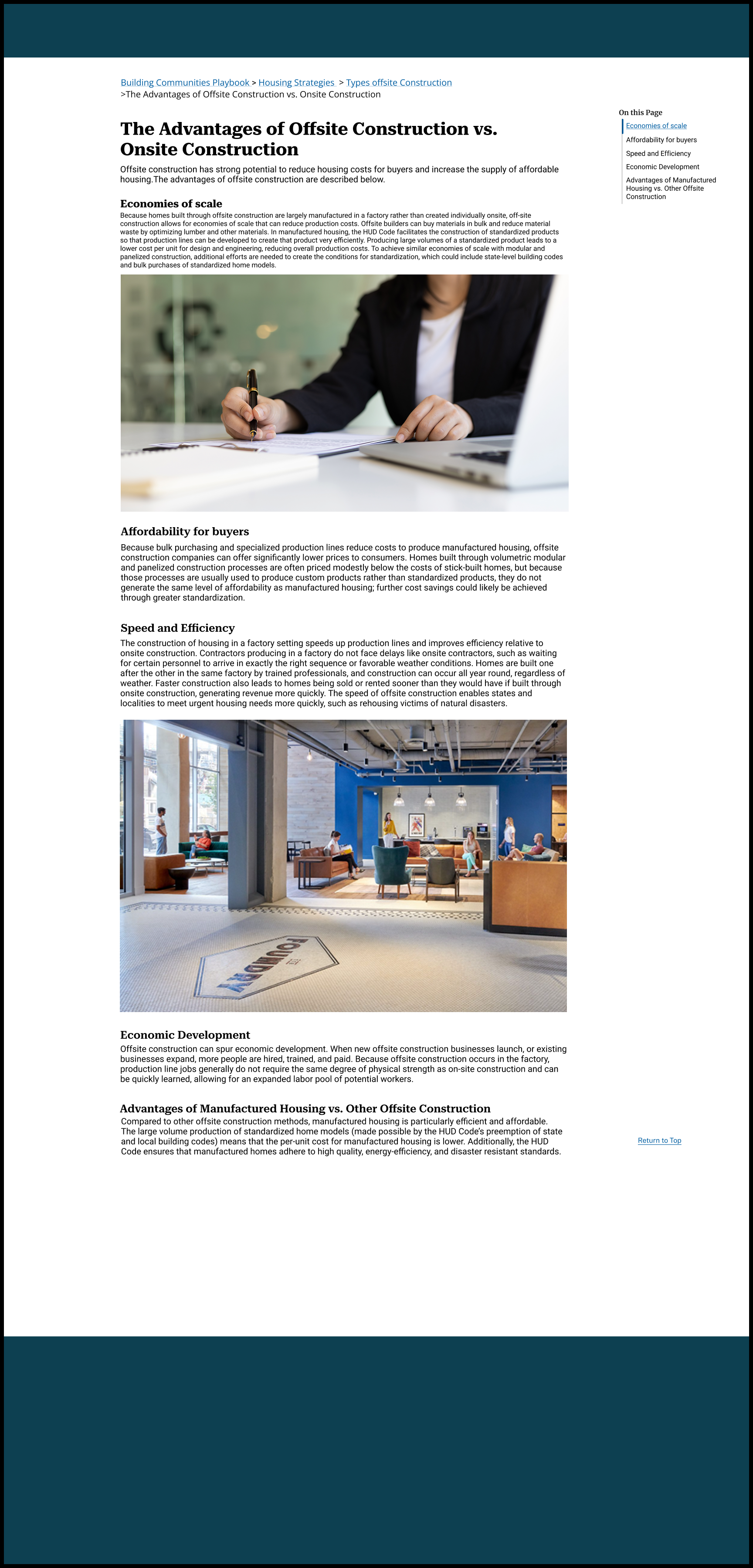
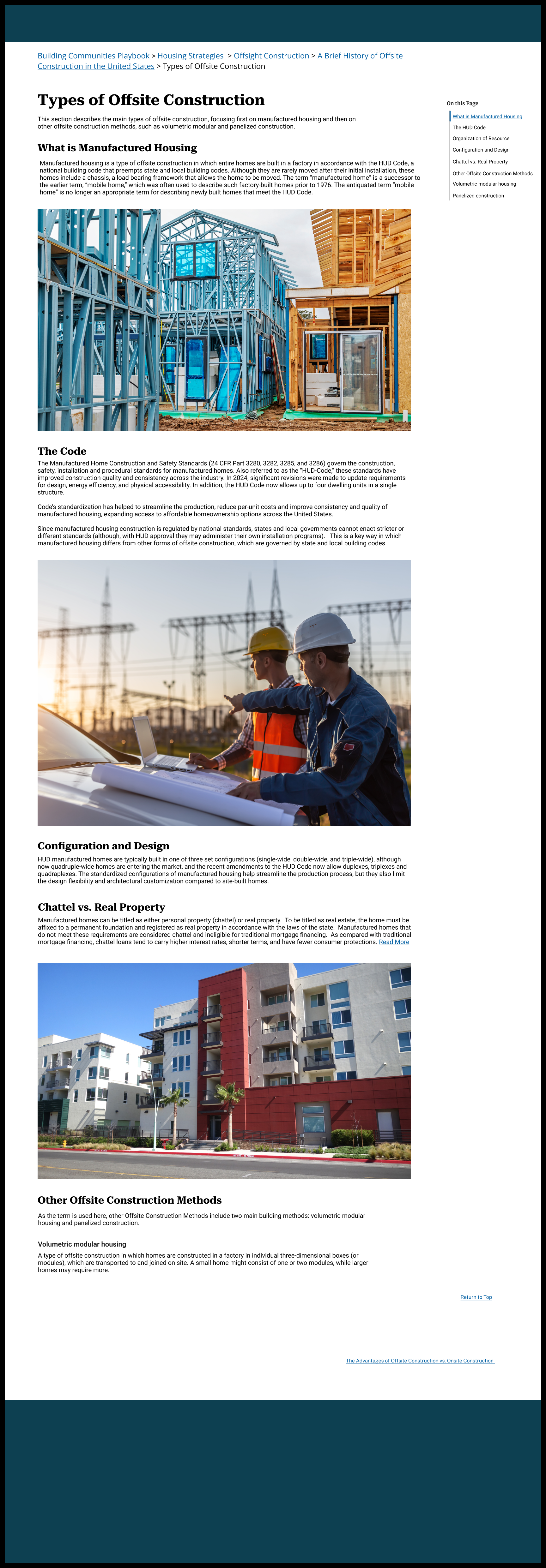
Testing findings fed directly into mid-fidelity wireframe updates, simplifying the homepage, increasing navigational breadcrumbs, and repositioning critical content above the fold.

Stakeholder presentations

Translated research findings into executive-ready presentations, using 100% user consensus data to prioritize localized filtering as the Phase 2 roadmap centerpiece.

From resource repository to guidance tool.

The testing results transformed the Playbook's design direction from a standard resource library into a user-centric guidance tool. Final recommendations prioritized relevance, discoverability, and challenges-based navigation, with the new IA approach now a core component of the Phase 2 implementation plan.

Recommendation 01
Impactful Discovery

Reposition critical content (success stories, strategy infographics) above the fold. Diversify imagery to reflect suburban, urban, and rural housing contexts for broader user identification.

Recommendation 02
Actionable UX Writing

Rename "Curated Resources" to "Learn More About [Strategy]" and replace generic FAQ-style labels with descriptive, action-oriented titles. Testing showed users ignored standard link labels entirely.

Recommendation 03
Granular Filtering

Integrate community size and region filters within the success story map. 100% of participants required this to trust the relevance of examples to their specific local context.

Recommendation 04
Challenge-Based IA

Re-center the entire navigation around "Housing Challenges" (e.g., high rental costs, lack of supply) rather than technical strategy names. Meet users at their problem, not at a taxonomy.

Challenge-based navigation architecture UX writing optimization Localized success story filtering Phase 2 AI-enhancement roadmap 100% target group representation

Four things that changed how I think about this work.

Lead with the Problem

Research confirmed users search by challenge, not by tool. Restructuring the IA around problem-based entry points wasn't just a UX fix; it was a fundamental reframe of what the product is for.

High-Stakes Recruitment

Low response rates from elected officials underscored the need for 8+ week lead times and internal partnerships to secure high-level stakeholder feedback.

UX Writing as Interface

Users ignored standard FAQ-style links entirely. Optimizing labels to be descriptive and action-oriented proved that copy is as much a design decision as layout.

Balanced Storytelling

Participants valued "Lessons Learned" as much as success stories. Broadening the content strategy to include risk-mitigation insights helped users avoid repeating common industry mistakes.

Back to the beginning

International
Energy Initiative.

View project All projects